What Gives a Shell Its Colours
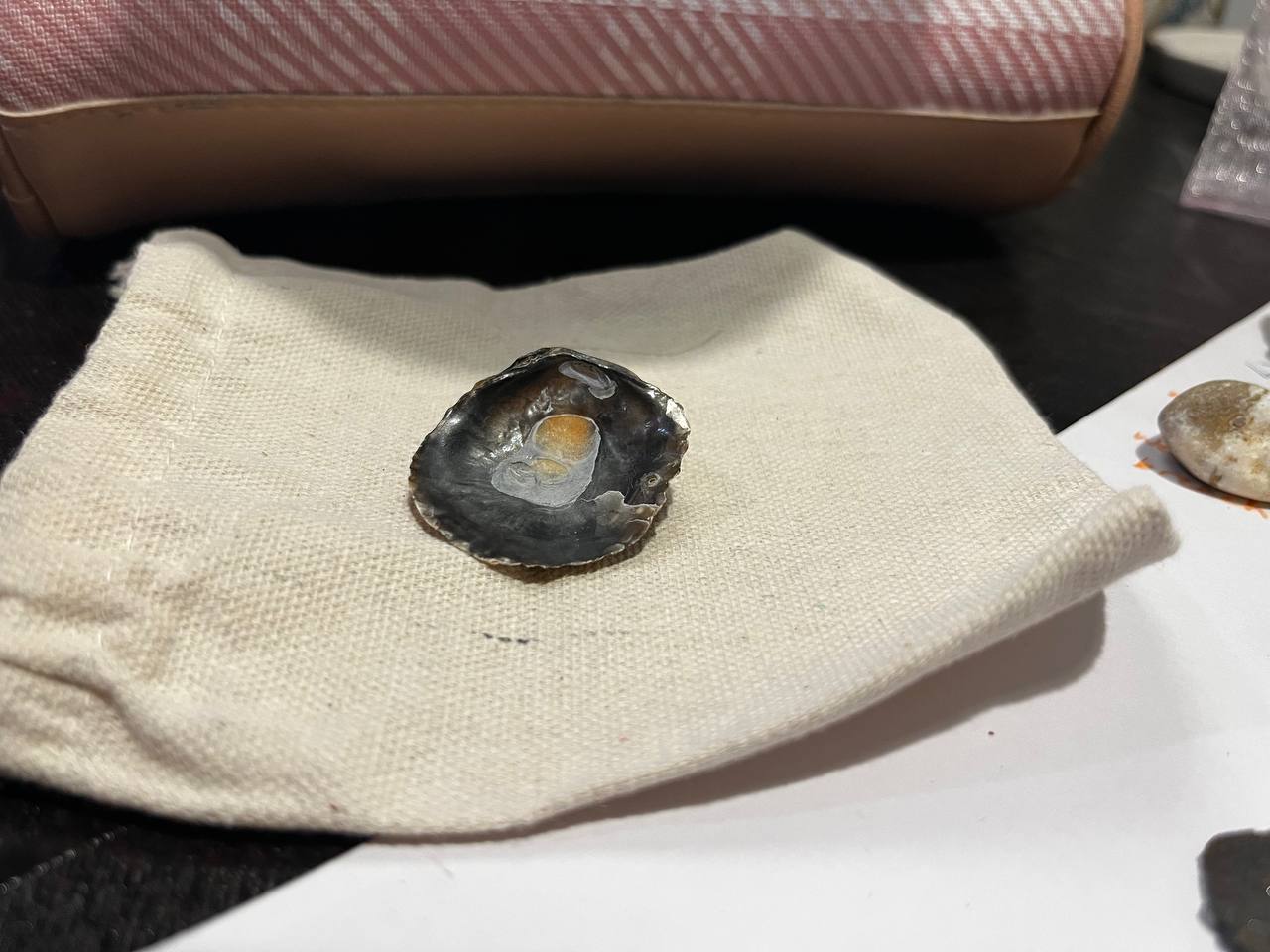
Amazing one to ask about — because the colours here come from three completely different mechanisms at once:
1. Pigments (real chemical dyes)
The animal’s mantle secretes coloured molecules straight into the shell as it builds:
- Carotenoids → yellows, oranges, reds (the warm orange blob here).
- Porphyrins & polyenes → pinks, reds, browns, purples.
- Melanin-type compounds → blacks and dark browns. These are actual pigments — the same families of molecules that colour carrots, blood, and feathers. The animal lays them down in patterns as it grows, which is why colour follows the growth bands.
2. Structural colour (no pigment at all)
That silvery, shifting, rainbow iridescence is not a dye — it’s pure structure. The shell’s inner lining is nacre: hundreds of stacked aragonite platelets, each only about 0.4–0.5 µm thick — right around the wavelength of visible light — cemented together by thin films of protein. Light reflects off the top of each platelet and off the layers beneath it, and those many reflections interfere: some wavelengths reinforce, others cancel. Because the surviving colour depends on the layer thickness and the angle you view from, it shifts and flashes as you tilt the shell.
It’s the same thin-film / diffraction-stack physics as a soap bubble, an oil film on a puddle, a peacock feather — and the rainbow oxide skin on bismuth crystals. None of those hold a coloured pigment either; the colour is made entirely of geometry and the wavelength of light.
The tell: pigment colour stays put when you tilt the shell; structural colour (the iridescence) moves and flashes. This shell has both — fixed warm colour and shifting silver nacre.
3. Staining (added after death)
Once on the beach, shells also pick up colour from the environment: iron oxides (orange/rust), manganese (grey/black), and organic matter. The dark, smoky tones around the edges here are largely this.
The raised orange dome
See that smooth, rounded boss sitting proud of the inner surface? That’s most likely an incipient blister pearl. When a sand grain or a parasite lodges against the shell wall, the mantle doesn’t wrap it into a free, round pearl — it simply plasters nacre over it where it sits, leaving a dome still fused to the shell. Its warm colour is pigment and a little iron riding on that nacre — so this one spot tells all three stories at once: structure (the nacreous dome), pigment (its colour), and a dash of staining.
So the full answer: pigment molecules + light-interference in the nacre + mineral staining — chemistry, physics, and weathering layered on one little shell.
Filed under the natural-artifacts collection. See also: seashells, mussels-and-nacre.