White Quartz Pebble
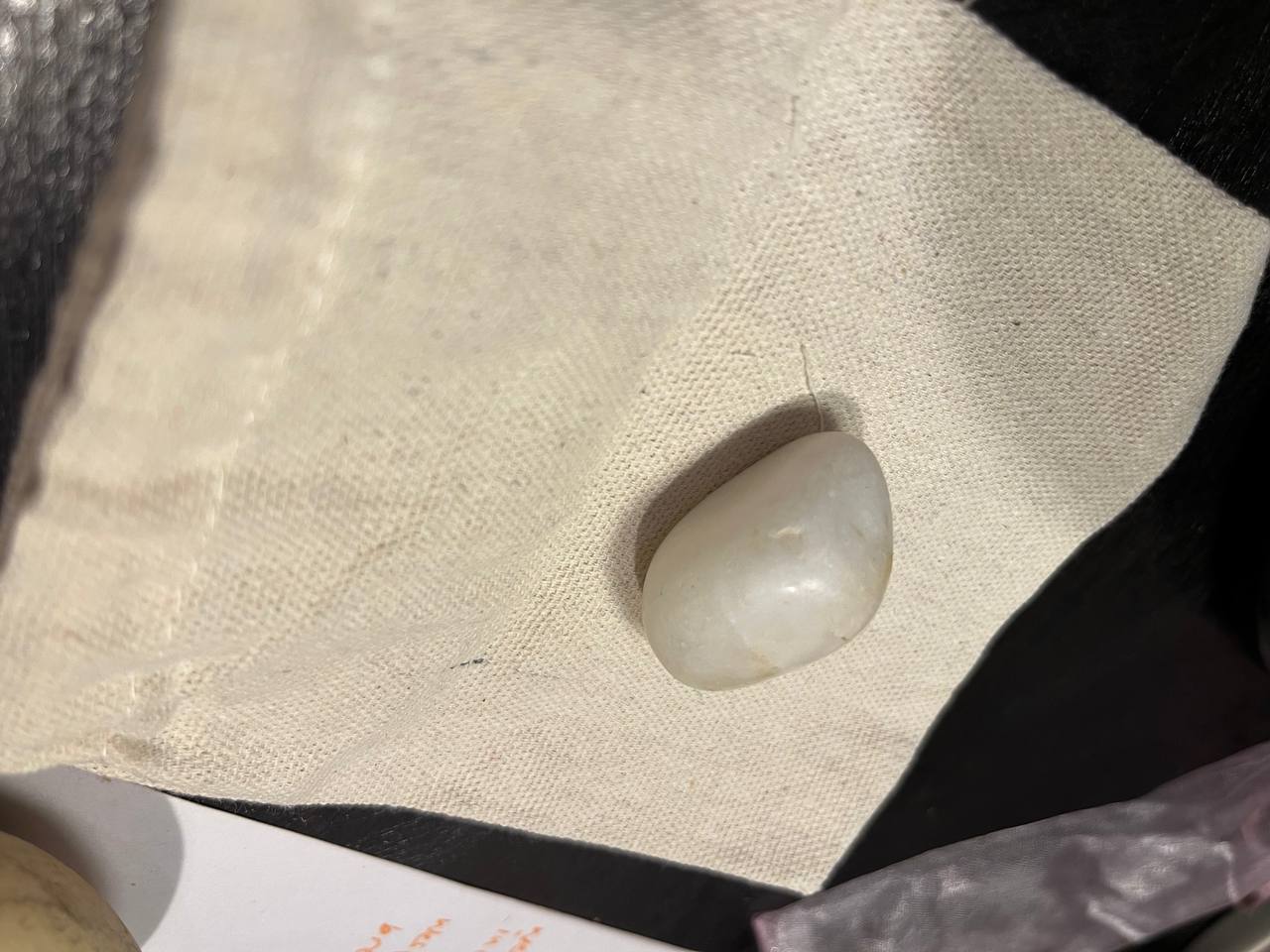
Most likely identity: Milky quartz pebble (quartz = silicon dioxide, SiO₂), water-tumbled into a smooth rounded shape.
Visual ID is provisional. Two quick at-home tests confirm it: (1) Hardness — quartz is 7 on the Mohs scale, so it will scratch glass and a steel knife will not scratch it. (2) Acid — a drop of vinegar will not fizz on quartz (if it fizzes, it’s a carbonate like marble/calcite, which is much softer). A greasy/waxy sheen on broken surfaces and curved, shell-like (conchoidal) fractures also point to quartz.
What it is
Quartz is the second most abundant mineral in Earth’s crust (after feldspar) and is pure crystalline silicon dioxide (SiO₂) — the same chemistry as window glass and beach sand, but in ordered crystal form. “Milky quartz” is the cloudy white variety. The rounded, edge-less shape means this piece has been tumbled — rolled against other grains in a river, beach, or a rock tumbler until smooth.
Why is it white?
Here’s the nice counter-intuitive part: pure quartz is colourless and transparent (that’s rock crystal). The milky white isn’t a pigment or an impurity element — it’s an optical effect. During crystallisation, the quartz trapped millions of microscopic bubbles of water and carbon-dioxide gas, plus tiny healed micro-fractures. Light hitting all those sub-microscopic surfaces gets scattered in every direction instead of passing straight through, so the stone reads as opaque white.
It’s the exact same physics as why clear ice is see-through but crushed ice and snow are white, or why clear glass looks white when shattered into powder. Same material, just full of tiny interfaces that scatter light.
Do the lines / patterns mean anything?
Yes — they’re a record of its history:
- The faint internal veils and cloudy streaks are planes of fluid inclusions — sheets of those trapped water/gas bubbles, often marking where the crystal healed an old crack as it grew. They’re essentially fossilised snapshots of the hot, mineral-rich water the quartz grew from.
- The hairline marks are fractures. Quartz has no cleavage (no flat planes it likes to split along), so it breaks in curved, glassy conchoidal surfaces — a diagnostic quartz trait.
- The smooth, rounded, edgeless form tells you about transport: it’s been rolled and abraded for a long time by water (or a tumbler). A freshly broken quartz vein is sharp and angular; this one has travelled.
Where is it found?
Quartz is genuinely everywhere in continental crust. Milky quartz specifically forms in:
- Hydrothermal veins — hot silica-rich water moving through cracks in rock, depositing quartz as it cools. (The classic white quartz vein cutting through a hillside.)
- Pegmatites — very coarse igneous rocks.
As loose pebbles it collects in riverbeds, beaches, and gravel deposits worldwide. In India it’s extremely common — Himalayan and Deccan river gravels, the Aravalli ranges, and quartz-vein country across the peninsula. So unless there’s a known collection locality for this specimen, “a riverbed or beach” is the honest provenance.
Filed under the natural-artifacts collection.