Tiny Spiral Snail — and the “Other Thing”
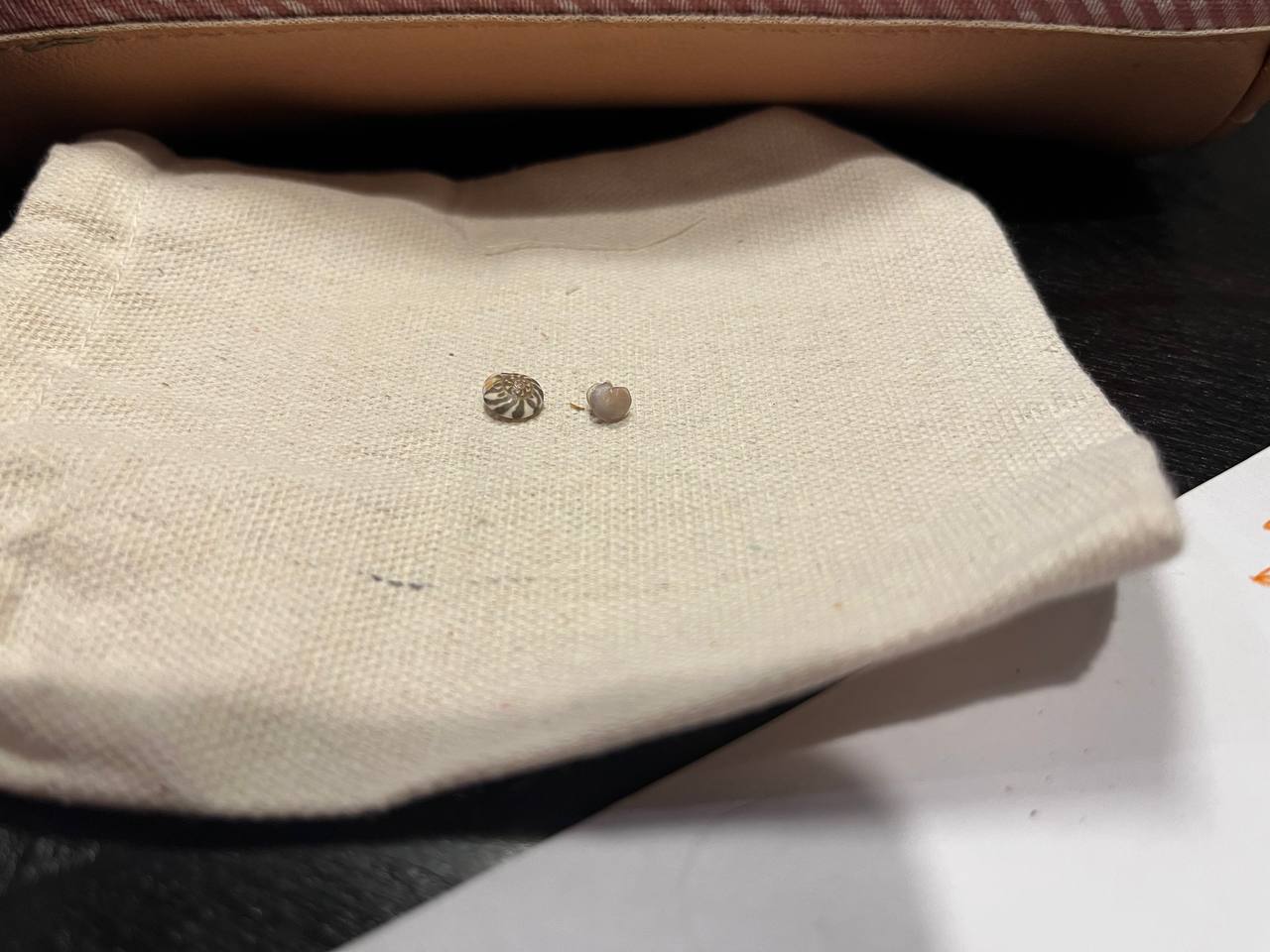
Two tiny objects here. Left: a small coiled snail shell (a gastropod) seen from the top, showing the spiral and dark radial bands. Right: almost certainly an operculum — the little “trapdoor.”
How does that complexity come about?
This is one of the most beautiful facts in all of biology, and your instinct (“so much complexity in such a tiny thing”) points right at it: the complex spiral is generated by an extremely simple rule.
The snail builds its shell only at the opening (the aperture), adding new material to the lip its whole life. Because it adds a little more on the outer edge than the inner edge, each increment turns the tube slightly — and if it keeps the proportions the same as it grows, the shell traces a logarithmic (equiangular) spiral: a curve that looks identical at every scale, just bigger. The animal never “plans” the spiral; it just keeps obeying one local rule — add proportionally at the lip — and the global spiral falls out automatically. Complexity from a simple iterated rule. (It’s the same maths as a nautilus, a sunflower head, or a galaxy arm.)
- The black/dark bands: the snail’s mantle edge releases pigment in pulses as it builds — so colour gets laid down in stripes that follow the growth direction. Same mechanism as the bands on the clam shells: a pigmented growth diary.
- The spiral ridges/sculpture: small rhythmic variations in how fast the lip is secreted.
What is the other thing?
The small rounded, slightly pearly object beside it is most likely an operculum — the hard “door” that many sea snails carry on their foot and pull shut behind them to seal the shell when they withdraw (protection from drying out and predators). When the snail dies, the operculum often drops out as a separate little disc, which is why it’s sitting next to (not inside) the shell. (If it’s instead chalky and flat, it could just be a small worn shell cap — hard to be 100% from the photo.)
Where found
Tiny spiral snails like this live in the intertidal zone — on rocks, seaweed, and sand worldwide — and their empty shells collect in beach drift. India’s coasts are full of them.
Filed under the natural-artifacts collection.