Screw / Tower Shells
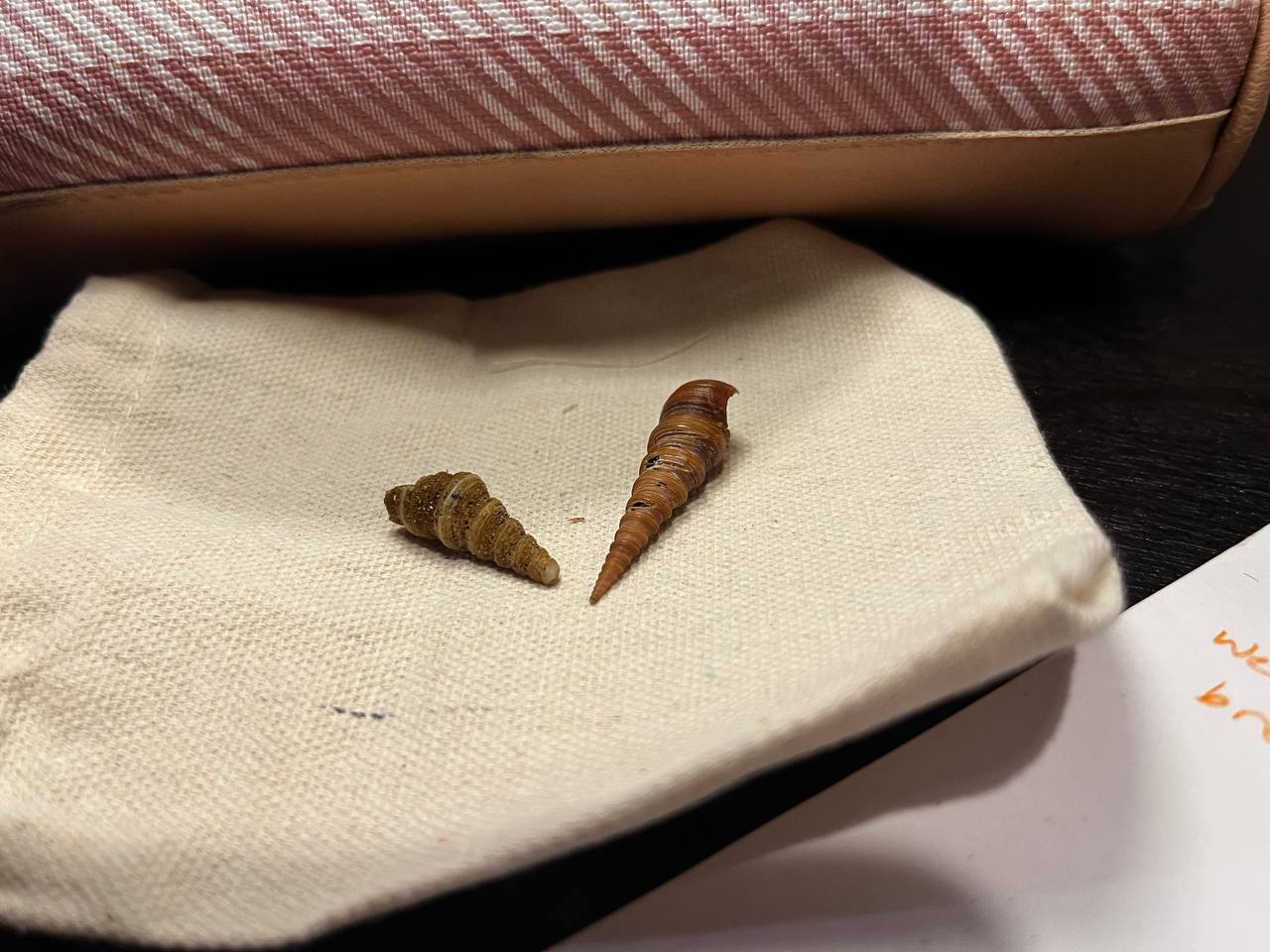
These two are high-spired sea snails — gastropods whose shells are long, pointed cones made of many tight whorls:
- The short, knobbly brown one → a tower / horn shell (a cerith, family Cerithiidae, or a small turret) — note the beaded spiral ridges.
- The long, slender, sharply-pointed one → a screw shell or auger (Turritellidae / Terebridae) — many smooth whorls winding to a fine point.
Why so complex and beautiful
Same magic as the little spiral snail (spiral-snail): the animal only ever adds shell at the opening, following one local rule, and a logarithmic spiral falls out — here stretched into a tall cone instead of a flat coil, because each new whorl is added a bit below the last (a higher “translation rate” down the axis). One parameter change in the same growth rule turns a flat snail into a tower. That’s why seashells feel mathematically designed without any designer — they’re physics + a growth rule iterated thousands of times.
The whorl count, the angle of the spire, and the sculpture (beads, ribs, smooth) are species fingerprints. They’re built of the usual calcium carbonate (aragonite) + protein.
How they live
High-spired snails like these are mostly burrowers and sand-dwellers — the streamlined tower drills into sediment easily. Augers (Terebridae) are predators that hunt worms in sand; ceriths graze algae and detritus on mudflats. Their empty shells are a beach-drift staple worldwide, India’s coasts included.
Filed under the natural-artifacts collection.