The Pebble with Lines
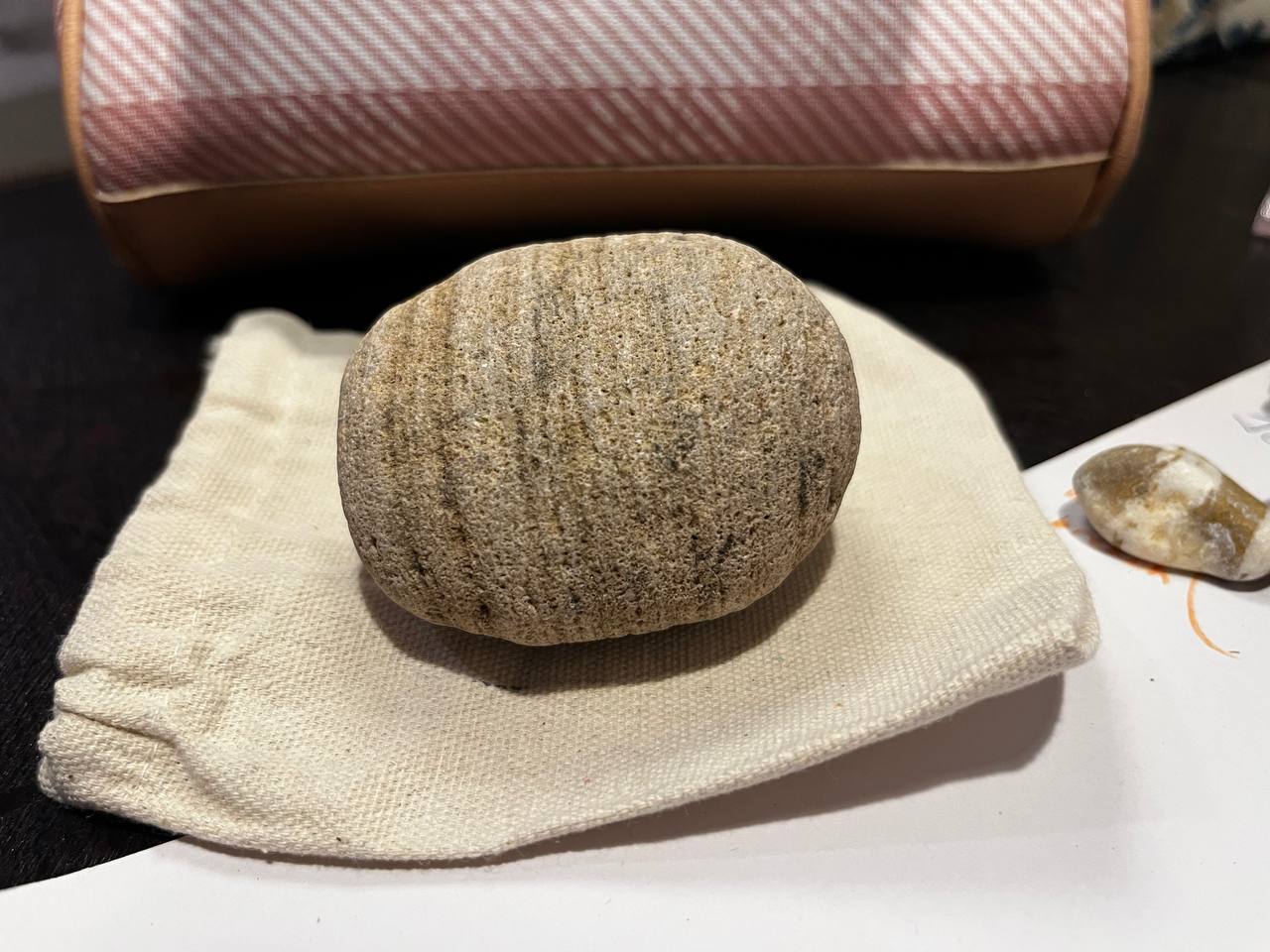
Those fine, roughly parallel lines wrapping around the pebble are sedimentary layering (bedding / laminations) — and they mean this stone was built up grain by grain, layer by layer.
What the lines are telling you
- Long ago this was loose sediment — sand and silt settling out of moving water (a river, a delta, a shallow sea).
- It settled in thin layers, and each time conditions changed slightly — a flood, a season, a shift in current, a change in grain size or mineral — a new, faintly different layer was laid on top. Darker/lighter lines = coarser/finer or iron-richer/poorer layers.
- Over ages the pile was buried, compacted, and cemented into solid rock (a sandstone / siltstone).
- It later weathered out and tumbled into this pebble — but the layering survived as those stripes.
So the lines are time made visible — like pages of a book or rings in a tree. Each line is one episode of deposition; reading them bottom-to-top reads the order in which they happened (the law of superposition — the foundation of how geologists read Earth’s history). The fact that they’re slightly bent/curved means the layers were gently warped after they hardened.
(If the lines were instead glassy and interlocking with sparkly minerals, they’d be metamorphic banding — but the even, fine, parallel look here says sedimentary bedding.)
Filed under the natural-artifacts collection.