Jingle Shells
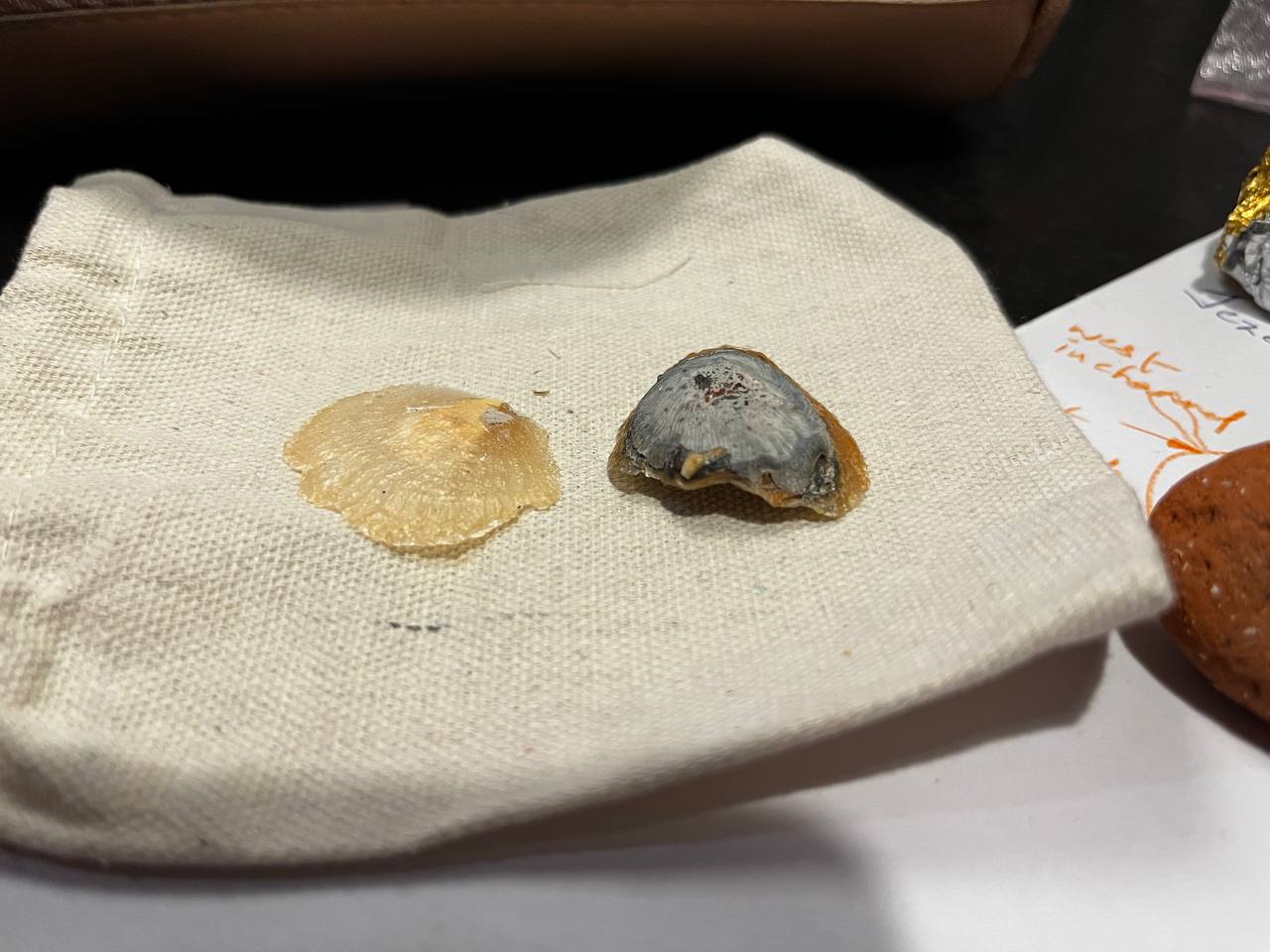
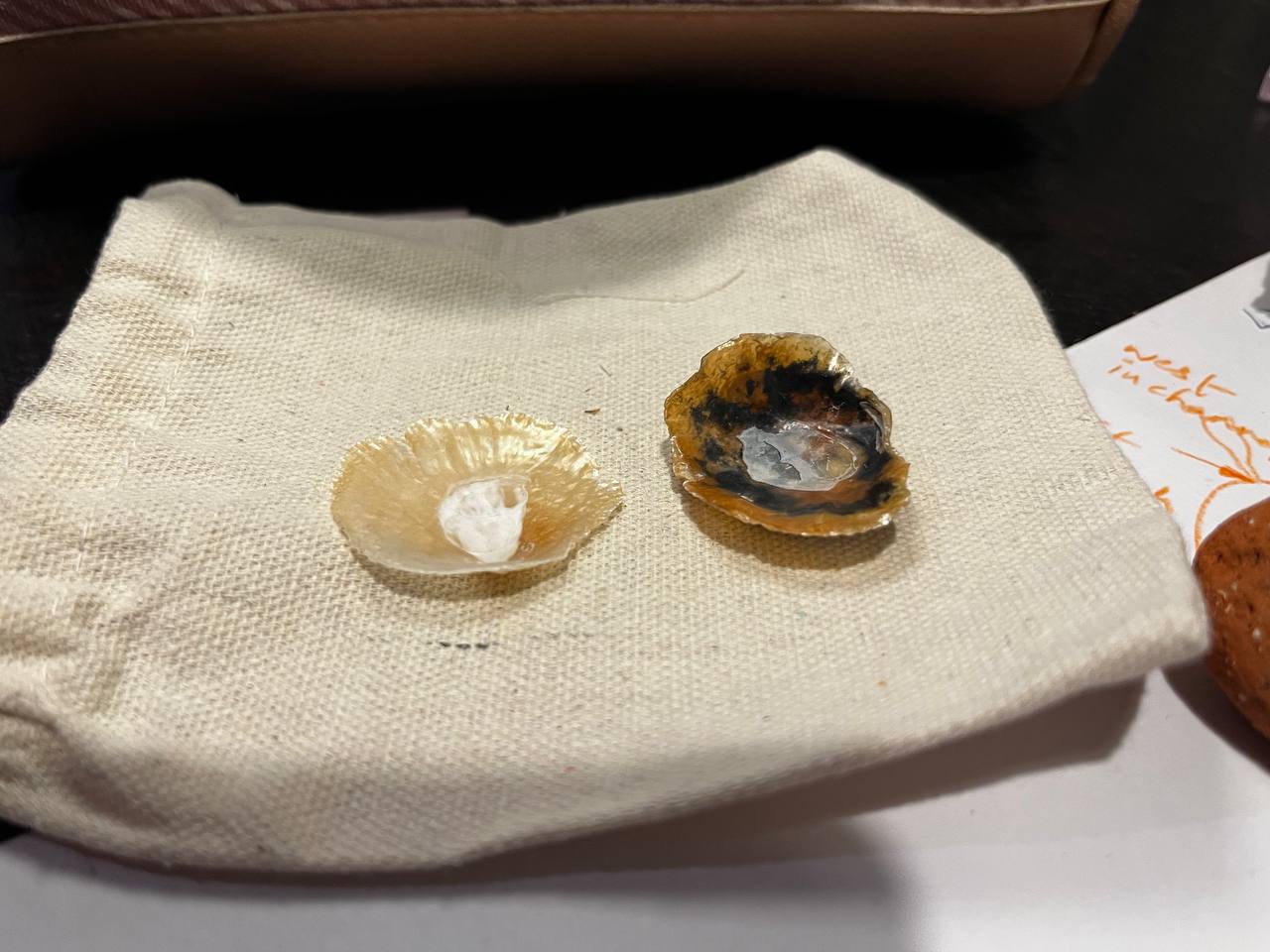
You’re right that these are truly different from the others — and the “almost transparent” one is the giveaway. These are jingle shells / saddle oysters (family Anomiidae), sometimes called “mermaid’s toenails.”
Why one is almost transparent
Jingle shells are extraordinarily thin and built largely of calcite in very ordered, even layers, with little pigment. Thin + ordered + low-pigment = light passes through instead of scattering, so they look translucent gold/amber — almost glassy. (Compare the milky quartz pebble, which is the opposite: white precisely because it’s full of light-scattering inclusions. Here there’s nothing to scatter the light, so it stays clear.) The darker one has picked up iron/organic staining (the black-and-amber patches), which is why it reads grey-blue rather than see-through.
The tell-tale hole
Look at the cupped (bottom) view: there’s a hole or a smooth plug near the top. Jingle shells live cemented to rocks and other shells, and they send a calcified byssus (anchor) through that hole to grip the surface. That foramen (hole) is diagnostic — no other common beach shell has it. The top valve is the pretty translucent one; the bottom valve (glued down) has the hole.
What they’re made of & where
Calcium carbonate (mostly calcite) on a protein scaffold, like all shells — just unusually thin and pure, which is the whole reason for the translucency and the faint pearly sheen. They wash up on rocky and sandy shores worldwide; people thread them into wind-chimes because they jingle — hence the name.
Filed under the natural-artifacts collection.