Cowrie Shell — and a Dark Find
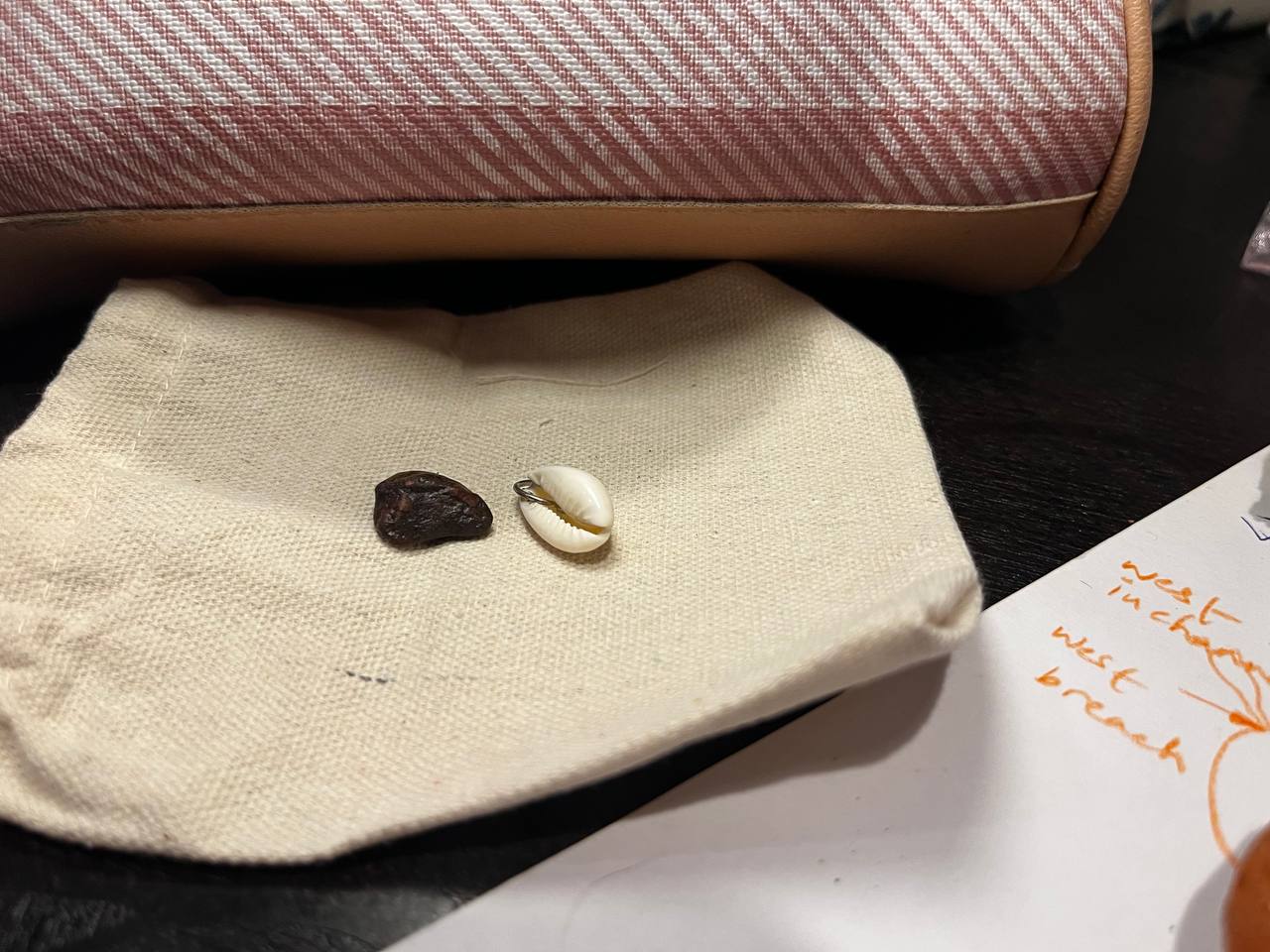
Right: a classic cowrie (family Cypraeidae) — the glossy, egg-shaped sea-snail shell with a long toothed slit underneath. Left: a dark, wrinkled object (most likely a dried drift-seed or a horny operculum — see below).
The cowrie — how it forms & what it’s made of
A cowrie is a gastropod (sea snail) shell, built of calcium carbonate (CaCO₃, as aragonite) on a protein scaffold, like all the shells here — but with a twist that explains the shine:
- In most snails the shell’s outer surface is dull. In a living cowrie, the animal’s mantle wraps up and over the outside of the shell from both sides and continuously lays down a glassy enamel glaze. So the cowrie polishes itself from the outside in — no weathering needed. That’s why cowries gleam like porcelain straight off the beach.
- The toothed slit is the narrowed aperture; the “teeth” are ridges guarding the opening against predators and grit.
- It still grows as a coiled spiral inside — the final adult coil just thickens and folds over to make the smooth dome.
Why it mattered to humans: cowries (especially the money cowrie) were used as currency across Asia and Africa for millennia — durable, countable, hard to counterfeit. A genuinely historical artifact.
The dark wrinkled thing
Harder to call from a photo. Two likely options — and you can tell them apart instantly:
- A drift seed (a “sea bean” — a plant seed that floated ashore): would be woody/light, and it’s plant matter (cellulose, lignin), not carbonate.
- A horny operculum (a snail’s trapdoor) or a worn dark snail: would be hard/stony or horn-like, and a shell one would fizz in vinegar.
If you tell me whether it’s light-and-woody or hard-and-stony (and whether vinegar fizzes), I’ll lock the ID.
Filed under the natural-artifacts collection.